Showing posts with label fantasy fiction. Show all posts

Saturday, March 10, 2012

On the Blue Comet

On the Blue Comet by Rosemary Wells.  Candlewick, 2010.

On the Blue Comet was a pure joy to read.  My childhood memory of pressing my cheek against the train board to gain a eye/ground level view of the trains was echoed in this story.   The story's main character, eleven year old, Oscar Ogilvie is a kindred spirit as he performs the same ritual. We both were trying to imagine ourselves into the small world of the trains.

When I was a child, we had a model train set up.  We did not have a basement but my father designed a over-sized folding platform for our HO model trains which included a train we had actually ridden on, the Santa Fe Railway Super Chief.

Wells sets her story during Great Depression. Oscar and his father share a love of model trains and they have an elaborate set up in the basement of their house.  Each year they add to their collection but the hard economic times have put a stop to that.  In fact, things are so bad that they must sell the train set to the local bank manager who uses the trains as a display in the bank lobby.  Oscar's father leaves to look for work in California, promising to send for Oscar when he finds some.  The kindly night watchman at the bank allows Oscar to visit and run the trains after the bank closes.  One night the lobby is invaded by bank robbers and Oscar escapes into time and an unlikely landscape.

This story mixes history, time travel, and fantasy along with cameo appearances by some famous people in history.  A great deal of the reading fun was identifying the people Oscar comes in contact with. 

Bagram Ibatoulline has contributed glowing paintings that have been meticulously researched.  Period fashion and architecture are reflected in illustrations which allow the reader to reach back in time too.

The book reminds me of how much model trains added to our childhoods. We learned -- hands-on --about electricity, direct current, transformers as well as trouble-shooting, patience and craftsmanship. 

Friday, October 22, 2010

Sadness: Eva Ibbotson

It was with terrible sadness that I read the news that Eva Ibbotson died yesterday.

The Star of KazanI discovered Ibbotson as a new school librarian and wondered why I had not found her earlier. I inhaled her ghost stories including The Great Ghost Rescue, The Haunting of Granite Falls, and Dial-a-Ghost  which are wicked-funny as her displaced spirits do their best to survive in a modern world that really has no time for apparitions.   Her novels The Star of Kazan and Journey to the River Sea have a heart-felt charm and elegance that are timeless.

Dial-a-GhostMagic and fantasy overlay Island of the Aunts, The Secret of Platform 13 and Which Witch.  The pairing of her stories with the cover art by  Kevin Hawkes was an inspired choice.

Ellen Potter's The Kneebone Boy and Suzanne Selfors's novels  continue of the tradition of "magical whimsy" that Ibbotson did so well.

I never read an Ibbotson novel that I didn't love.The closest I've ever come, as an adult, to recreating that time of reading "unconscious delight" that I knew as a child was when I was reading her works.

Reading Ibbotson is like taking a vacation to a time and world apart. Luckily I have still not read them all. I have many more trips to look forward to.

Wednesday, September 15, 2010

Eragon's Guide to Alagaesia

Eragon's Guide to AlagaesiaEragon's Guide to Alagaesia  by Christopher Paolini, illustrated by Fred Gambino, Larry McDougal, Ian Miller & David Wyatt.  Knopf, 2009. (review copy from publisher)

Teacher's  kids are a poorly served, school population.  Especially, if they are unfortunate enough to attend the same campus where their parental unit works. These poor children, are trapped, trapped likes rats in a maze, on campus while their hard working educator parent strives to wind up the loose ends of the day, prepares for the morrow, attends meetings...and the list goes on.  

Eragon (Inheritance)Alas, these children must resign themselves to doing homework, sleeping, reading or otherwise entertaining themselves until their mother packs up for the day and heads home. One way of coping is to go "visit" other teachers which is how I first heard about Eragon.  One of my students would come by, regularly, to urge me to read this wonderful new book her family had purchased, from the author himself, at a local bookstore.  "It's Eragon," she said. "Aragorn?" I would answer.  "Nooooo, ERAGON!" 

She was one of the readers who found the book when Paolini was still self-publishing it.  Oh, how she LOVED this book. Once I discerned the difference between Aragorn and Eragon, I read the it. I had to push my eyeballs across the page for the first quarter of the book but was able to finish it and could see its appeal though I prefer The Professor myself.  

Brisingr (Inheritance)Eldest (Inheritance)Paolini drew on every fantasy novel he had ever read to write the series. He was just a kid when he wrote Eragon.  It is hardcover fanfiction, essentially.

What has been interesting to me is the following the series  has continued to enjoy. I've had students tell me, earnestly, that Eldest is their favorite.  I personally do not know anyone who actually read Brisingr

Eragon's Guide to Analgaesia is designed in the style of the "Ologies" books (like Pirateology, Dragonology, Wizardology) with maps, fold-outs, mini books, flaps etc. Dragons, weapons, landscapes, abodes and creatures are all rendered as encyclopedic illustrations. 

Illustrators, Gambino et al are no Alan Lee/John Howe, but their fantasy illustrations are lush and detailed. The book had a textured iridescent blue cover that recalls Saphira, the dragon from the first book.  So, are they implying the book is bound in dragon skin?? Yikes!  (I think "my" Dragon just fainted.)
I sent my young friend, who is now in graduate school,  my copy of this book.   She has a new apartment and a new coffee table that needs a coffee table book.  I told her that this book will be no match for the images in HER imagination or HER memories of reading and loving this book but it might be a fun souvenir of that time. 


Saturday, May 08, 2010

Stoneheart Trilogy

Stoneheart Trilogy, Book One, The: Stoneheart (The Stoneheart Trilogy)I am late to the table discovering  this series.   

Stoneheart (Hyperion, 2007) by Charlie Fletcher is a page-turner with an intriguing focus for a fantasy novel.

George , 12 years old, breaks off the head of a dragon carving from the wall of the museum during a class field trip.  Uh-oh.  This action opens the way into an unseen dimension of London where all the statues of the city are good (the spits) and trying to help him or bad (the taints) and trying to kill him. He meets a girl named Edie who has the unwanted ability to see past events. 

For this Anglophile, the most delightful aspect to these books (I am in the middle of the second volume, Ironhand) is identifying the REAL statues and public art in London that are characters in the story.   
Stoneheart Trilogy, Book Two, The: Ironhand 
The cover art for Stoneheart IS the  Temple Bar Griffin or Dragon.
Locating the statues and memorials in the story has turned into a kind of obsession right now.  Some of the ones that I have identified include Boadicea and her daughters, Peter Pan, the Royal Artillery monument,  the Black Friar Pub and more

The audio books are read by the wondrous, Jim Dale. He is so firmly the voice of Harry Potter for me that I do not always enjoy his readings of other books, but this series is OUTSTANDING.  The storyline, characters and locales play to all his strengths as a narrator.  
The Stoneheart Trilogy, Book Three: Silvertongue

Fletcher is improving as a writer.  Ironhand is stronger than the first volume. (Must identify the statue on the cover now.)  The final volume Silvertongue should be a cracking read.


Update:  Found the statue on the cover of Ironhand.  It is  the Cnihtengild, Devonshire Square.

More statues:

Terra-dactyl from Natural History Museum (Stoneheart, Silvertongue)

Arial (Ironhand)
Hodge (Silvertongue) 
Wellington Arch (Silvertongue)
Dictionary aka Dr. Johnson 
The London Stone (Silvertongue)
WWI Memorial - the old soldier and the (grand, bloody, panjandrum of the painfully bleeding obvious) young soldier   (outside the Royal Exchange) (Silvertongue)
The Duke with no stirrups outside the Royal Exchange  (Silvertongue)
The Firefighters Memorial (Silvertongue)
Anteros from the Shaftesbury Memorial in Piccadilly Circus (Silvertongue)
Cleopatras Needle Sphinxes- Victoria Embankment - another view and another (Stoneheart, Silvertongue)
Merchant Navy Memorial - Jack Tar (Silvertongue)
Richard the Lionheart and a close-up (Silvertongue)
Queen of Time at Selfridges
Shackleton aka Shack @ Royal Geographical Society
Queen of America and "Bill" the buffalo from Albert Memorial
Is Railway Man Isambard Kingdom Brunel?
The Knight of Wood @ Southwark Cathedral

Renaissance Man holding a feather quill @ Southwark Cathedral

The Admiral
Bulldog
Boy with a Dolphin

Discovering London Statues and Monuments
 By Margaret Baker

Monday, February 01, 2010

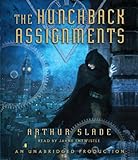
The Hunchback Assignments


The Hunchback Assignments #1 by Arthur Slade , read by Jayne Entwistle, Listening Library, 2009 (review copy source: public library audiobook download) // Hardcover edition: Wendy Lamb Books, Random House, 2009. (review copy source: publisher provided)

Arthur Slade brings new life to Victor Hugo's 1831 classic, The Hunchback of Notre Dame and resets the story in Victorian England. His twist on the story mixes Robert Louis Stevenson's Dr. Jekyll and Mr. Hyde into a steampunk adventure with human robots (or is it robotic humans?) and explosions and intrigue.

Initially, I wondered how much appeal this story would have with readers who are at an age when they probably feel like Quasimodo yet yearn to be Edward Cullen. Would they bond with a such an ugly and physically malformed main character?

Yes.

Not only is Modo a kind and intelligent character but, as voiced by Jayne Entwistle, he is endearing and charming. His innocence about the world and his learning curve are similar to the eye opening time of life that starts in junior high school.

Mr. Socrates is a member of a mysterious society, the Permanent Association, whose mission is to safeguard the Empire, "Rule, Britannia" and all that. He rescues an abused and terrified hunchbacked child, Modo, from a traveling freak show and provides tutors who educate and train the boy. The child has a special power to physically change his appearance although it takes continuous concentration and physical effort to maintain a new visage for any length of time. Modo is isolated and protected from the outside world and even from his own appearance until he is fourteen years old.

When Modo is fourteen Mr. Socrates gives him a mirror and he sees himself for the first time in his life. Reeling from that shock, Socrates then turns him out onto the streets of London to test his survival skills, his intelligence and his special abilities. Surviving and even thriving, he is teamed with another teen, Octavia Milkweed, to infiltrate and defuse a plot to overthrow the British government.

Slade provides a wafting of romance as Modo yearns to be tall and handsome in order to gain Octavia's interest while she continuously wonders about the mask Modo wears--shades of Cyano's Roxanne and Hugo's Esmerelda.

I am looking forward to the next installment of Modo's story.
With the interest in the new Sherlock Holmes movie franchise, I think the timing for this series is excellent.

Thursday, February 26, 2009

Teen Reads

Both of these books offer readers a way to ponder important themes and ideas from the safe distance of another world or time.

Lurlene McDaniel and Phyllis Reynolds Naylor "Alice" style "problem" fiction never called to my own entlings. They preferred fantasy and were drawn to the other worldliness of imaginary landscapes and characters with special powers. Still, good fantasy literature engages in important issues, ideas and emotions which is why it continues to be such a popular genre. Carla Jablonski's and Dia Calhoun's novels are thought provoking and memorable.


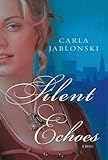
Silent Echoes by Carla Jablonski, Razorbill, 2007

Lucy Phillips and her father are scamming the gentry of 1880's New York City. Posing as a medium, Lucy pretends to contact their dear-departed during séances. Her conscience pricks her as she offers false hope to grief stricken family members but her empty stomach bothers her more so she endures and aids her father's swindles. To her utter shock, one night in the middle of a séance she hears a real voice in her head begging, " Help me!"

The voice she hears is a present day teen named Lindsey who is hiding in her bedroom closet to escape the alcoholic rages of her mother and step-father.

Both Lucy and Lindsey are shocked by the contact. Lucy thinks she has really made contact with a ghost, while Lindsey suspects she may be spiraling into mental illness.

I am a sucker for time shift-time travel books and I was drawn in to each girl's story. Lindsey is struggling to succeed in school and life while dealing with her mother's drinking problems. Lucy is trying escape grueling poverty. How the girls use this connection through time to help each other is the gist of this tale.


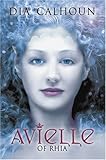
Avielle of Rhia by Dia Calhoun, (a founding Diva of Readergirlz) Marshall Cavendish, 2006

Avielle is the only survivor of a terrorist attack on her royal family. Because of the color of her skin and her resemblance to an evil ancestor, she has always been distrusted and held at arms length by her family and the people of her country. Avielle, herself, worries that the evil magic of her great-great grandmother will surface in her even though she seems to lack any of the magical abilities of her family.

Still in danger from the fanatics, she leaves behind her real identity and finds refuge with a kindly weaver who introduces Avielle to a community of artisans. The weaver teaches her to weave. Not only does she find acceptance here but through her weaving she begins to discover her magical talent and the truth about her great-great grandmother.

This is a fantasy world but the disasters recall the Holocaust and 9-11. Calhoun examines prejudice, terrorism and hate that allows evil to triumph. Avielle can become a true leader when she lets go of her own self-hatred and bitterness and accepts the love and responsibilities of her birthright.

Tuesday, January 29, 2008

To Catch a Mermaid

To Catch a Mermaid 

To Catch a Mermaid by Suzanne Selfors, illustrated by Catia Chien, 2007

In an instant, Boom and his sister Mertyle lost their mother when a twister touched down in their front yard and swept her away. No trace of her was ever found causing their father to quit work and retreat to the attic in fear of the tornado's return.

Mertyle is certain that her mother will return so she stays home from school every day to wait for her. The family is barely functioning. Short on funds, Boom brings home a bucket of seafood rejects for their for dinner. Beneath the seaweed and fish, he and Mertyle find a merbaby and, soon, a world of trouble when Mertlye is stricken with a mysterious illness. Catia Chien's humorous illustrations underline that this merbaby is not the Garth Williams cherub from my childhood storybook nor is it a Disney baby Ariel. Rather, it is a growling, stinky, burping, razor-fanged creature that is a danger in many ways.

This is a light-hearted, middle grade reader but below the fantasy the story addresses the painful loss of a parent. Boom is a character to admire as he pushes forward when others in his family are paralyzed by their loss. I give Selfors great credit for the direction of the story. She surprised me with the ending which made the story richer and more meaningful.

All in all, a fun and very satisfying read.

Wednesday, December 05, 2007

Science Fiction and Fantasy Reading Suggestions

Author Tamora Pierce has a great list of some of her favorite fantasy and science fiction reads. Entling no. 3 is a huge Pierce fan. I'm pointing her to this list.

Tuesday, January 09, 2007

The Fetch


The Fetch
by Chris Humphreys, 2006

My daughter was sifting through my stack of books and picked this one to read. When I asked her why that particular book, she answered, "It has runes on the cover."
Me: "It does?"
So, you see, she was already a leg up on me when she started the book. She l-o-v-e-d this story and cannot wait for the sequel.

I enjoyed The Fetch very much and I understand why it was such a hit with her and why it will gain a devoted fanbase as it becomes better known. If you are a junior high /high school librarian I suggest you add this book to your purchase order right now because your Eragon, Lord of the Rings, Sea of Trolls readers will love this book.

Sky is seeing thing or dreaming thing. He sleepwalks and animals are talking to him. His parents have already had him checked out by psychiatrists and doctors so he doesn't tell them about his latest visions.

He is drawn to an old sea chest that belonged to his deceased grandfather Sigurd where he discovers a hidden bag of runestones and a journal. When his cousin Kristin arrives for a visit, he shares the find with her and the two of them set about unlocking the secrets of the runes.

Their research uncovers the existence of the Fetch, the spirit of a person that can be visible as a body double or can inhabit other beings or animals. Their experiments with runecasts send Sky's fetch traveling back in time to inhabit their ancestor, Bjorn, a young Viking. Through Bjorn's eyes, Sky lives through Bjorn's first Viking raid and to his horror, discovers his inner-Berserker.

As they delve deeper into rune magic they are drawn into the mystery of their grandfather Sigurd's disappearance and a danger, neither could have foreseen.

The book has lots of sword clashing, ax-thowcking action. Humphrey's experience as a fight choreographer is apparent. In the author's note at the end of the book he writes:

When I first considered writing this novel, I remembered what I'd read in my teens--historical fiction, preferably with plenty of battles, self-sacrifice, blood-shed; and horror, the scarier the better.

My daughter cannot wait for the next book in the series, Vendetta, which will be out in August 2007.

I like Humphrey's writing. Being the Richard Sharpe military historical fiction fan that I am, I have started reading his Jack Absolute series. I am enjoying seeing the American Revolution from "the other side." He blogs about his writing at Quintessence of Dust.

C.C. Humphreys Website

Friday, December 22, 2006

Eragon: fan devotion, books and movies


Years ago, when I was a daily school librarian, one of my "reader" students, B, used to come by the library office after school to talk about books. Like so many teachers' kids (my own entling included) she was trapped at school until her parental unit finished the day's paperwork and prepared for the morrow.

She asked me over and over again if I had heard of this new book called Eragon. Since I had LOTR standups of the fellowship all around my library I would ask, "You mean Aragorn?" No, Mrs. P--ERAGON!

B and her family had met Christopher Paolini at a local bookstore where he was selling copies of this book that he had written and his family had published. Her younger sister had ended up in a pleasant and lengthy conversation with Paolini so their mom went ahead and purchased a copy of the book from him. I think B read the covers off her copy. Later she complained that the new edition that Random House brought out was different from her "original" edition.

I finally did read Eragon. The first 100 pages were an absolute slog. Normally, I would have abandoned the effort but my young friend's earnest devotion to the story compelled me to keep going even though I had to physically push my eyeballs from one word to the next.

At some point the story grabbed me and I enjoyed the last half of the story. Was the story derivative? Oh yes. Paolini is a devotee of Lord of the Rings, Dragonriders of Pern, Star Wars and it shows in every character, plot twist and set piece.

What continues to interest me though is how much kids still love this book. The second book, Eldest, has a devout following also. I have not read it -- my own entling did read it but was not very enthusiastic. It circulates frequently at the libraries where I sub and I know kids who think it is better than Book 1. Is it Paolini's teenager perspective that resonates with the kids?

The entling wanted to see the movie so earlier this week we rounded up some friends and popcorn and zoomed off the local multiplex.

I did not have high hopes. The reviews had not been kind and every word of this review in School Library Journal rings true (I liked this review because the reviewer has obviously read the book.)

On the whole though I enjoyed the movie. The dragon technology is amazing. Jeremy Irons never turns in a bad performance and I thought Edward Speleers did a perfectly acceptable job as Eragon, the dragonrider. I personally don't "get" John Malkovich and his delivery in a fantasy piece echos "Yondah lies the castle of my faddah" but we are not in the Oscar stratosphere here. The director obviously stole his vision from The Two Towers but if you are going to ape your betters, then Peter Jackson is the place to start.

Not having the book committed to memory may have improved my enjoyment. There were heapings of bitterness about the short shrift given to Murtagh and the compression of time on the way home in the car.

I expect I would have had the same reaction to Anthony Horowitz's Stormbreaker if it had ever reached my fair city. Michele at Scholar's Blog writes about Horowitz and his reaction to the limited release of Alex Rider in the USA. Michele enjoyed Stormbreaker and since she has pointed me towards some other good movies, I feel like I would have enjoyed it too. I will watch for it on Netflix.

Wednesday, November 08, 2006

Monster Blood Tattoo


Monster Blood Tattoo: Foundling
by D.M. Cornish, 2006

Monster Blood Tattoo was a complete surprise. The story of the young Rossamünd Bookchild, is an interesting and engrossing read. The mood, tone and characters are very Dickensian. D.M. Cornish has amplified the effect with his own illustrations that evoke George Cruikshank and Phiz.

Rossamünd is small for his age and afflicted with a regrettable name. He is facing the day he will be apprenticed with a mixture of anxiety and hope. Raised with relative kindness in an orphanage, he dreads leaving the protection of the mothering Verline and the tough old sailor, Fransitart. Rossamünd dreams of becoming a sailor and battling monsters just like the heroes in the stories he reads. He soon learns he will be employed as a lamplighter though and he accepts his new future.

His first steps into the wider world of the Half-Continent land him in danger and at the mercy of a brutal smuggler. The Half-Continent is a world where people are set on exterminating the monsters that roam the countryside. Rossamünd begins to doubt the stories of monster horror he has heard all his life when he encounters a beautiful but strange lahzar or monster hunter named Miss Europe.

This novel is a prelude and ended much too quickly. I thought I had a goodly number of pages left to read but the last third of the book is a glossary of terms or “explicarium.”

Cornish has set us up for the next book, perfectly. We know we have not seen the last of the brutal Gosling, Rossamünd’s nemesis from the orphanage and what is the secret Fransitart needs to tell Rossamünd?

I know the striking cover and title will resonate with teens. Last week I was driving some of my daughter’s friends home, when one of the kids saw the book next to her on the back seat. She was immediately drawn to the book (“Woah, look at this!” to quote exactly) and was very happy when I told her she could take it home with her.

Sunday, October 22, 2006

Pond Scum


Pond Scum by Alan Silberberg, 2006

Alan Silberberg's Pond Scum is full of fun and heart and is a hoot to read. Pond Scum will even tempt those nonfiction-reptile-amphipian-reading boys and girls to drop those DK Eyewitness books and try a novel for a change.

The hilarious opening chapter sees a hapless real estate agent attempting to show the old ramshackle house by the pond to some prospective buyers only to be dive bombed by every insect, bird and mammal in the area. The agent and house-hunters run for their lives. No sale!

Oliver and his sister have been uprooted from their home in the city when their newly divorced mother takes a job as a teacher in a small community. Against her better instincts, the real estate agent tries, once more, to unload the old house on this newly-arrived family. Despite what seems to be yet another organized attack on them by the local insects and animals, their mother takes a shine to the old run down house and decides to buy it.

Moving does not really bother Oliver as his only friends are television characters and his idea of a good time is watching TV and tearing the wings off house flies. School is just something else to be endured like his father's infrequent and rushed visits with him and his sister.

The lack of a television signal is making Oliver crazy though. When he attempts to install a rickety antenna on the roof, he is attacked by crows. His plummet through the roof of the house lands him in the attic where he finds a mysterious gem stone that will change his life.

The stone allows him to change form and join the animal kingdom. Unlike Narnia or Neverland, Oliver's secret new world is just outside his front door. He discovers the natural world with his new best friend, Mooch the salamander. Nature is not paradise though as the cruel and power mad crow, General Santo Domingo, is preparing to grab control of the animal Alliance and rule over all the animals of the pond.

Along with the scum and goo and slime and plenty of eewwwwww-ness, Pond Scum also considers the importance of friendship, brother-sister relationships and finding your place in the world.

I am looking forward to booktalking this novel and getting the book into the hands of my reading friends.