Tuesday, August 17, 2010

A World of Hurt

Crank
Pete Hautman has eloquently framed and explained a truly unfortunate and sad episode in the point of light that is the Teen Lit Fest in Humble, TX.  His post "The Nasty Thing in the Corner" describes how author Ellen Hopkins was invited (she accepted) then DIS-INVITED from the event.  DO read his post and all the comments.  Chris Crutcher's thoughts are so on target.

School Librarians
First of all, as a school librarian, I cannot imagine having to un-invite an author or illustrator to my school. How horrible.  We DO read the books, right?  We KNOW the author's work, right?  We understand the books and WHY they connect so profoundly with our students, right?  We have communicated this to our administrations, right?

Lost opportunity
 

Wouldn't it have been an interesting part of the festival to have a panel on this very subject? Parents could have asked questions, there could have been a discussion, views could have been exchanged, ideas shared, opinions aired...an impassioned, thoughtful tussle over books and how they affect us.

Public relations
This is SUCH bad public relations for the Humble school district when you KNOW the superintendent just wanted the whole thing to go away so he could get back to worrying about drop-out rates and school safety. Of course, a discussion of Hopkins's book could have actually helped with drop-out rates and school safety, alas. Instead, he has put the district under a magnifying glass.  He has demonstrated that he does not trust his district's professional librarians who chose and invited the authors. That does not build confidence.

Parents

I have no idea about the identity of the parents who kicked this off but I would lay odds they were parents of junior high or early high school students. Those years are so difficult for parental units as they see their control over their kids and the school eroding. Elementary schools are the most responsive to "parent input" but that sensitivity diminishes as the years pass.  I believe that these protests are often a last gasp at trying to 'have it your way.'

Also, wearing my parent hat here now, I always thought it would be better to have my kids experience the dangerous corners of life, through an intense and realistic novel rather than try them out in real life.  Please, kiddies, just read about what it is like to get involved in (insert name of life-threatening behavior here) and experience the consequences between the covers of a book!


Book Challenges
Certainly, this was NOT a formal book challenge but it smacks of one.  A book challenge NEVER helps a community.  I like to point out to parents that it lands you forever on a list, Yearly Lists of Challenged and/or Banned Books,  that NEVER goes away. The community is enshrined there, on the .pdf, in a Book Banning Hall of Infamy. 

Adults as readers
One of the saddest thing about any challenge or ban, is that it points out how poorly parents (and superintendents) fare at reading with the same level of discernment and insight that they demand of their students.

As educators we ask students to (just to name a few):

(5)  Reading/Comprehension of Literary Text/Fiction. Students understand, make inferences and draw conclusions about the structure and elements of fiction and provide evidence from text to support their understanding. Students are expected to:
(A)  analyze non-linear plot development (e.g., flashbacks, foreshadowing, sub-plots, parallel plot structures) and compare it to linear plot development;

(B)  analyze how authors develop complex yet believable characters in works of fiction through a range of literary devices, including character foils;

(C)  analyze the way in which a work of fiction is shaped by the narrator's point of view; and

(D)  demonstrate familiarity with works by authors from non-English-speaking literary traditions with emphasis on classical literature.
...
   ...   ...
(7)  Reading/Comprehension of Literary Text/Sensory Language. Students understand, make inferences and draw conclusions about how an author's sensory language creates imagery in literary text and provide evidence from text to support their understanding. Students are expected to explain the role of irony, sarcasm, and paradox in literary works.

(8)  Reading/Comprehension of Informational Text/Culture and History. Students analyze, make inferences and draw conclusions about the author's purpose in cultural, historical, and contemporary contexts and provide evidence from the text to support their understanding. Students are expected to explain the controlling idea and specific purpose of an expository text and distinguish the most important from the less important details that support the author's purpose.
from Texas Administrative Code (TAC), Title 19, Part II
Chapter 110. Texas Essential Knowledge and Skills for English Language Arts and Reading §110.31. English Language Arts and Reading, English I (One Credit), Beginning with School Year 2009-2010.
I daresay, Hopkins' books fill the bill in all those TEKS.  Seriously, shouldn't  parents and administrators have to demonstrate similar insight?

I feel  sorry for Hopkins, all the other authors who were invited to participate (what a position THEY are in now) in what should have been a festive event.

As usual, when adults behave badly, students fare worst of all.   I am really, truly sorry. 


UPDATE: 
Ellen Hopkins posted about the incident on her blog here and here.
She notes "To date, four other authors—Pete Hautman, Melissa de la Cruz, Tera Lynn Childs and Matt de la Pena—have withdrawn, in a solid stand against censorship."

Friday, August 13, 2010

Tolkien and Dickens collaborate

The Hobbit: 70th Anniversary EditionWISHFrom The Guardian:

Tolkien and Dickens collaborate, that is, their descendants are working together.
Michael GR Tolkien, the eldest grandson of JRR Tolkien has written a new book, Wish.

The audiobook of Wish is narrated by actor, Gerald Dickens, the great-great grandson of Charles Dickens. 

Sort of fun to ponder.  The cover art certainly seems familiar...

Friday, August 06, 2010

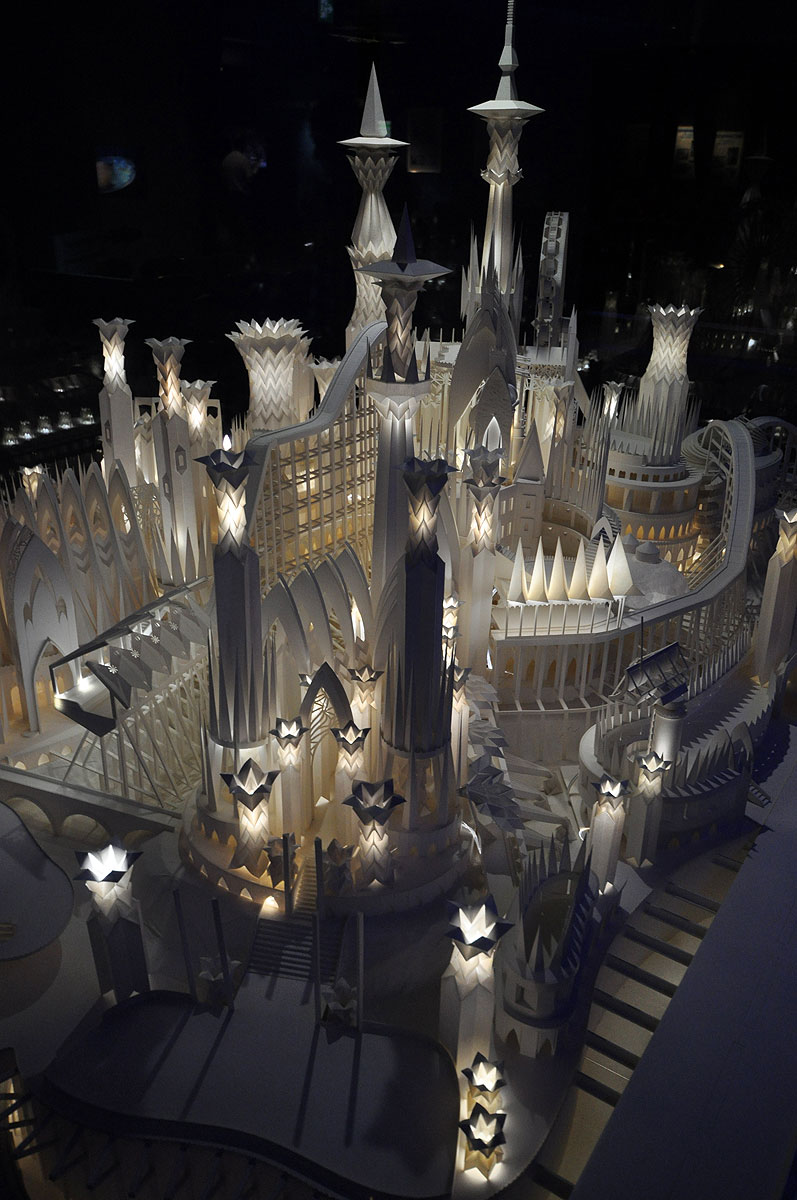
Papercraft masterpiece

Wataru Itou (伊藤航) created this amazing...beautiful...!!!!!!!!!!  No words.  More photos here at Tokyo's Bling Blog.
Thanks to Sommer Leigh for pointing me here.

Wednesday, August 04, 2010

Movie: Flipped

FlippedFlippedComing soon to a theater near you:
Flipped by Wendelin Van Draanen 

Flipped was selected for the 2003-2004 Texas Bluebonnet book list. It has been that long since I read it but it was my favorite title on the list that year.  I thought it was a terrific book for 5th grade (and beyond.)  It is a sweet and sympathetic look at kids as they move from childhood to tweens to teens.

Bryce and Juli alternate telling the story.  Second grader Bryce is appalled by Juli's enthusiasm for him and her chickens. As they hit junior high though, he decides there is something about Juli that he quite likes --  just as she is about done with him forever as he shows no appreciation for her family, her chickens or her special tree.

Much of the book's wonderful humor comes from their two different perspectives of the same events.   I will be interested to see if they even try to  translate this to the screen.  Rob Reiner directs.  I wonder how this book arrived on his radar.
 I hope the movie is worthy.


Wendelin Van Draanen website

Saturday, July 31, 2010

How do you know it is a celebrity author book?

PW announced that Disney has signed Major League Baseball Hall of Famer Cal Ripken Jr.to write a baseball series.  

Ripken, bless him, may be the next Matt Christopher, Phil Bildner, Mike Lupica, authors who write (Christopher died in 1997) engrossing stories, using sports as a frame. 

I hope his series is a success.  Still, how do you know it is a celebrity author book?  

All together now, boys and girls, "when they use the word LESSONS in the publicity. "

Ripken says,
“Connor is a character that I was able to help develop with Kevin based on my experiences as a kid who struggled with his emotions. I hope that the kids reading it find it to be fun and take away a few lessons from it.”
The first book will be titled Hothead.

Thursday, July 29, 2010

Any old rubbish?

Thank you to 100 ScopeNotes for directing me here: Twilight Saga: how to write a children's best-seller By Philip Womack.

Read the whole article, it will help with the "cat" thing.

Successful children’s books tap into a child’s hunger for the safe made strange. They rejuvenate ancient folktales of order rising out of chaos. They speak to a child’s subconscious and form its collective experiences. Rowling and Meyer do all this, with enough metaphorical cats killed between them to fill a small cemetery. Whatever their literary merits, the books act as forerunners to a bewildering grown up world, where evil is dressed as glamour and where ordinary people are called to be heroes.

Wednesday, July 28, 2010

Team Shark? Team Train?

Shark vs. TrainShark vs Train by Chris Barton,  illustrated by Tom Lichtenheld, Little, Brown, 2010

I loved this photo from the Blue Rose Girls wrap-up of ALA.  Team Shark or Team Train? Who is superior?  That is a question that could lead to an inspired library lesson.  If you need some help, Little, Brown has a Shark vs Train website, with posters and activity sheets to download.

Tom Lictenheld's comic illustrations are delivered with broad, over-the-top humor and subtle nudges which will delight the book's audience of kids and kids of a "certain age," as the French say.    A sly and canny wit underpins the project which comes from  Chris Barton's inspired concept of a shark and a train, trying to out-do each other.  The story is a celebration of children and imaginative play.  

If it is not on your library shelf yet,then this is a must have for your school library's first order of the year.  

In fact if you don't have Barton's 2010 Sibert Honor biography, The Day-Glo Brothers: The True Story of Bob and Joe Switzer's Bright Ideas and Brand-New Colors, illustrated by Tony Persiani, Charlesbridge, 2009, in your library, you best get a copy of it too!


Tuesday, July 13, 2010

The Wednesday Wars

The Wednesday Wars
The Wednesday Wars by Gary D. Schmidt.  Scholastic Audio Books, 2007
As an author, it must be a tricky thing to listen to the audiobook of your work.  You've labored over the voice, the tone, the dialogue, the...the...ellipses.  To hear another voice reading the story could be so odd. 

Then, what if it all goes horribly off track? What if the bright folks at Corporate Audiobook Inc. get it completely wrong?  What if the narrator doesn't work or is a complete mismatch and they bungle the rhythm and dialogue the author so carefully crafted?


Wednesday Wars
Well, I hope Gary D. Schmidt was happy with Joel Johnstone because, it seems to me that Johnstone understood every word, every syllable and even the spaces BETWEEN the words of this Newbery honor book.  

I listen to a lot of audiobooks.  Some are enjoyable, some are bearable and some are un-listenable.    Scholastic Audio has produced a performance here that seems as close to a perfect melding of story and narrator as I have ever heard.

Oh, to hear Johnstone voice the teacher, Mrs. Baker  as she addresses Holling Hoodhood, with her crystalline:  "Mr. Hoodhood" or to experience Holling's lament of  the placement of the feathers on his costume for The Tempest -- these are moments I will long remember. 
  
I was  a seventh grader during the school year of 1967-68 and could,  totally identify with Holling's "still-too-young-to-fully-appreciate the-times-that-were-a-changing-but-old-enough-to-understand-that-something-was-happening-here"  state of mind.  Author, Gary Schmidt got that part exactly right.

I remember when classrooms had windows that opened, a concept that seem long ago and far away now.  I DO remember when a teacher, like Mrs. Baker,  could cross her arms in such a way that the class WOULD fall silent immediately

The Wednesday Wars
  is a novel with characters so real  and authentic that I found myself missing them between listens.  This book is a celebration of teaching and learning and what students learn from dedicated teachers and what teachers learn from dedicated students.

While all the Jewish and Roman Catholic kids in his class are at religious instruction on Wednesday afternoon, Holling Hoodhood, a Presbyterian, is the only student left at school.  His teacher, Mrs. Baker must also stay, as a result.  Holling is sure she hates him for it.   As Mrs. Baker and Holling embark on a study of Shakespeare on these Wednesdays,  he finds more connections than he could have ever guessed, between his life and the words of the Bard.   He also gains insight into the life of his teacher whose husband is fighting in Vietnam.  

Gary Schmidt is a very clever writer.   I burst out loud laughing as Holling attempts to navigate seventh grade in spite of accidents, death threats, deadly rats, diagrammed sentences, a flower-child older sister and a distant and opportunistic father. 

Glorious story, brilliant audiobook.

I am not sure how many kids have discovered this book. Classroom windows do not open anymore in my corner of the world, but the humor, the quandaries and vagueries of junior high school life are still spot on.  

Memo to self:  Must booktalk this title. 


Sunday, July 11, 2010

Library of the Early Mind

Ooooooooo!   Ahhhhh!  Wowwww!  This could be splendid.
Library of the Early Mind, a feature-length documentary film about children’s literature directed by Edward J. Delaney and produced by Edward J. Delaney and Steven Withrow. The film is intended for festival release in 2010.


Friday, July 02, 2010

Fancy Nancy


Fancy Nancy: Every Day Is Earth Day (I Can Read Book 1)
Fancy Nancy: Every day is Earth Day by Jane O'Connor, pictures based on the art of Robin Preiss Glasser, interior illustrations by Aleksey Ivanov and Olga Ivanov. Harper, 2010.

This "I Can Read, Beginning Reading" level 1 book is a surprisingly canny look at saving energy and keeping an Earth Day outlook!

Nancy Yancy is helping her family make changes to be more "green."  She reminds her parents to ride a bike when possible, take a tote to the market, wear a sweater to stay warm instead of changing the thermostat and to use less water.  

O'Connor points to another aspect of conservation though.  As in real life, there are downsides to being "green" which Nancy has to face.  Pulling the plug on a computer to save energy, results in the loss of a project that Nancy's mother was working on.  When Nancy saves energy by turning off the light in her little sister's bedroom,  her sister awakens, in a dark room,  which terrifies her.  There are consequences to inflexible green policies.

Common sense tells us we can do a lot by following Nancy's simple rules. I would settle for everyone just picking up their trash at the movies to start.